


LINE: Calls & Messages
LINE (LY Corporation)
I have always found LINE most useful when messaging is not just about sending text, but about keeping a small circle of people connected throughout the day. It combines chat, voice calls, video calls, group conversations, and a lively sticker culture in one communication app. That makes it feel more expressive than a basic SMS tool, although it also means the experience can feel busier than a minimalist messenger.
My overall view is straightforward: LINE is a strong choice if your friends, relatives, classmates, or work contacts already use it. The network effect matters more here than any individual feature. A beautifully designed chat app is not much help if the people you need to reach are elsewhere. When your contacts are already on LINE, the app becomes a convenient daily hub; when they are not, convincing everyone to move can be the main obstacle.
How LINE works in everyday communication
Developed by LINE, part of LY Corporation, the app sits in the communication category and is available free of charge. It is suitable for Everyone, so its basic appeal is broad: families can use it for quick updates, friends can share reactions and media, and groups can coordinate plans without relying on separate tools for every conversation.
Related News

How LINE: Calls & Messages Is Redefining Communication

Why Snapchat Keeps Users Coming Back for More
In my experience, the most pleasant part is the way conversations can carry more personality than ordinary text messages. Stickers and emojis make short replies feel less abrupt, while voice and video calling let me move from a written exchange to a live conversation without opening another service. That is particularly handy when a family group is already active and someone suddenly needs to explain something rather than type it.
The app has been available since June 23, 2011, and its reach is substantial: it has passed a billion installs and has accumulated around fourteen million ratings, with an average of 3.3. Those figures suggest a very broad user base, but they also point to a practical truth. LINE is not a niche tool that depends on one type of user; it serves many regions and communication habits, so the experience can vary depending on who you know and how they use it.
Related News

Why WhatsApp Messenger Still Makes Everyday Communication Feel Easy

Jurassic World: The Game Is the Better Dino Tycoon for Strategic Players

Threads in Real Life: Who Should Join, Lurk, or Leave

How SHEIN Turned Shopping Into an Endless Content Feed

How to Make Fortnite Feel Smarter on Mobile

Should You Switch to Microsoft Outlook on Mobile?
A typical evening shows where it fits best. Imagine a family arranging a weekend meal. One person sends the location in a group chat, another replies with a sticker instead of a full sentence, and someone else starts a voice call to settle the details. The conversation remains in one place. Later, a relative who missed the call can read the messages and respond when convenient. That combination of asynchronous chat and immediate calling is more useful than it sounds because it avoids forcing every participant into the same schedule.
Chat tools that reward organized conversations
LINE works particularly well when I separate conversations by purpose. A family group, a close-friends chat, and a planning conversation are easier to follow when each has a clear role. I would avoid putting every topic into one giant group because the app can become noisy quickly. The same advice applies to stickers: they add warmth, but too many reactions can bury the message that actually contains the important detail.
One useful habit is to send a concise summary after a busy exchange. In a group chat, several people may answer at once, and a later participant can easily miss the decision. LINE makes rapid conversation comfortable, but it does not remove the need for basic group etiquette. If the chat is being used to coordinate travel, appointments, or shared responsibilities, I find short, clearly worded updates more dependable than relying on a stream of reactions.
Gallery
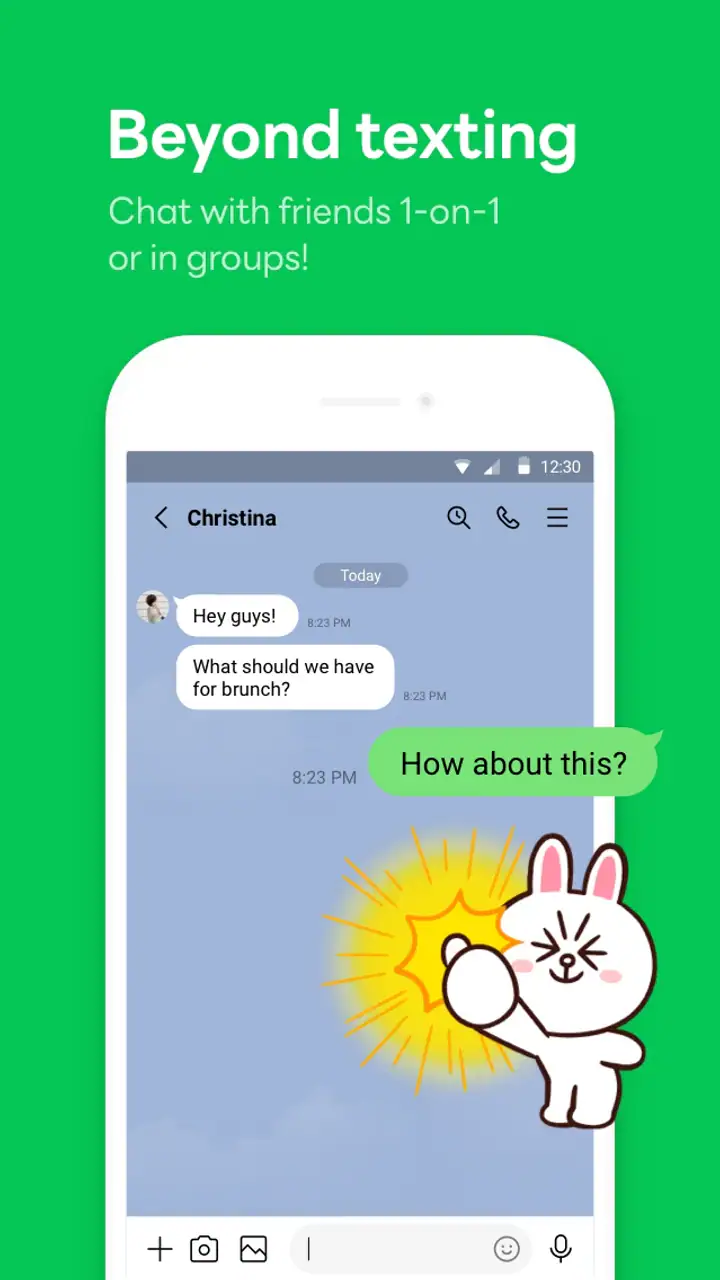
Another practical strength is the ability to choose the right communication mode for the moment. Text is best when the recipient may be busy, a voice call is better for a quick explanation, and video is useful when seeing the other person matters. Having these options close together reduces friction. I do not have to ask which separate app someone prefers before moving from a message to a call.
That convenience has a trade-off. People who prefer a quiet, stripped-down inbox may find LINE visually energetic. Stickers, group activity, and the wider ecosystem can make it feel less focused than a plain messenger. I see that as a matter of taste rather than a defect, but it is an important difference for anyone moving from a very simple SMS replacement.
Why the social layer matters
The sticker-based style is not merely decoration. In many conversations, a sticker can acknowledge a message without interrupting the flow with another sentence. It can also soften a correction, celebrate good news, or signal that a message has been noticed. I would not use stickers for every situation, but they give LINE a recognizable tone that standard messaging often lacks.
At the same time, the social layer can create pressure to respond. A lively group may produce a constant sequence of messages, calls, and visual reactions. If you are trying to keep communication strictly functional, the extra energy can become distracting. My recommendation is to treat group chats as rooms with different purposes: mute or ignore the less urgent ones when needed, and reserve your attention for conversations that genuinely require it.
This is also where LINE differs from a work-first platform. A service built around office channels and formal threads may be better for projects, files, and structured accountability. LINE feels more natural for personal relationships and informal coordination. It can support practical conversations, but I would not make it the center of a complicated professional workflow unless the whole group already works comfortably that way.
Calls and messages in real situations
For a quick family check-in, LINE can replace the need to combine a text service with a separate calling app. I like being able to start with a message such as “Are you free?” and then continue with a voice or video call if the answer is yes. That small transition feels natural, especially with relatives who may not want to manage several different communication services.
It is also useful for friends who live in different places and want more than occasional texts. A group can remain active between calls, while video conversations provide a more personal connection when schedules line up. The app is not a substitute for a reliable personal relationship, of course, but it does make regular contact easier to maintain.
For larger groups, my advice is to establish a simple rhythm. Put decisions in text, use calls for issues that are difficult to explain, and avoid assuming that everyone saw every message. This is not a special setting; it is a workflow that makes LINE more dependable. The app gives you several channels, but the people in the chat still need to agree on how to use them.
One less obvious consideration is contact adoption. If your closest contacts already have LINE, the app can feel effortless. If your circle is split between several messengers, you may end up checking multiple inboxes anyway. In that situation, LINE remains useful for the people who are there, but it may not become your single communication home. I would decide based on the habits of your actual contacts, not on the feature list alone.
Costs, purchases, and the practical trade-off
The app itself is free, which makes trying it straightforward. It also includes in-app purchases ranging from twenty-nine cents to $394.99 per item. That wide range is worth noticing because the core communication purpose should be separated from optional spending. I would approach purchases carefully and decide whether a sticker, theme, or other add-on genuinely improves how I communicate before paying for it.
For someone who only wants messaging and calls, the free entry point is the main attraction. You can evaluate whether your contacts use the service without committing money first. The presence of optional purchases does mean the surrounding experience can feel more commercial than an extremely bare messaging app, so users who dislike extras may prefer a simpler alternative.
The rating of 3.3 from roughly fourteen million ratings is mixed rather than glowing. I would not treat that number as a final verdict by itself. A communication app can be excellent for one person and frustrating for another depending on contact availability, group habits, device behavior, and expectations about privacy or simplicity. Still, the rating is a reminder to keep expectations realistic: LINE has broad reach, but it is not universally loved.
Where it beats familiar alternatives
Compared with ordinary SMS, LINE offers a more social conversation space and makes it easier to move between text, voice, and video. It is also more expressive, thanks to stickers and the app’s visual style. If your friends already use it, that can make everyday communication feel more connected than a collection of isolated text threads.
Compared with a minimalist messenger, LINE gives up some quietness in exchange for personality and a wider set of communication options. I would choose the minimalist option for someone who wants a clean inbox with as little visual activity as possible. I would choose LINE for a person who enjoys expressive chats and needs an easy bridge between messages and calls.
Compared with a work-oriented collaboration service, LINE is more comfortable for family groups, casual planning, and personal calls. A professional platform may be better when a conversation needs formal channels, task ownership, or carefully organized project history. LINE can coordinate a small event, but I would not confuse that convenience with a full project-management system.
Compared with a video-first service, LINE is better suited to conversations that begin with a message and only sometimes become calls. That is an important distinction. If your main purpose is scheduled group video meetings, another tool may be more appropriate. If you want a flexible personal inbox where calling is available when needed, LINE makes more sense.
Limitations I noticed before recommending it
The biggest limitation is dependence on your social circle. The app cannot create value in isolation. If the people you care about are committed to another messenger, LINE may become an additional inbox rather than a replacement. I would ask a few close contacts what they actually use before making it the center of my communication routine.
The second issue is visual and social clutter. A busy group can produce a constant flow of messages and reactions, and the expressive elements will not appeal to everyone. Users who want a restrained interface may find the app less comfortable than a plain text-and-call service. This is especially relevant if you already struggle with notification overload.
There is also a learning curve for people who have only used basic texting. The core actions are easy to understand, but the broader experience rewards users who take a little time to organize chats and decide how they want to handle groups, calls, and optional purchases. I would introduce it gradually to less confident relatives rather than expecting them to understand every part immediately.
Finally, I would keep sensitive communication habits in mind. Any messenger deserves thoughtful use, especially when conversations include personal information. I avoid sending details that do not need to be in a chat, and I check the recipient and group before sharing anything important. That is sensible practice with LINE and with every comparable service.
Who should use LINE?
I recommend LINE most strongly to people whose friends or family already rely on it. It is a good fit for households that want group chats and calls together, for friends who enjoy stickers and casual reactions, and for users who regularly switch between text and live conversation. It is also a reasonable first choice for someone who wants to try a free communication app without immediately paying for extras.
I would be more cautious about recommending it to someone who wants one quiet, uncluttered inbox, or to a professional team that needs formal project organization. It is also not the best choice if nearly everyone in your circle uses another service. In that case, the theoretically attractive feature mix matters less than the simple fact that your contacts are elsewhere.
For families, I suggest starting with one clearly named group and agreeing that important decisions should be written plainly. For friends, I would use stickers as an accent rather than letting them replace useful details. For people managing several communities, I would keep LINE for personal conversations and use a more structured tool for work that needs searchable responsibilities and deadlines.
LINE has earned enormous reach since its launch, and its developer continues to present it as a way to stay connected with friends and family. The short store label is simply “LINE,” but the actual experience is broader than a name suggests: it is a personal communication space built around messages, calls, groups, and expression.
My final verdict is positive, with one condition: choose it because your people are there. I like its ability to turn a quick message into a voice or video conversation, and I appreciate how stickers make everyday exchanges feel less mechanical. I also recognize that its energetic style, optional purchases, mixed average rating, and dependence on user adoption will not suit everyone. For the right circle, though, LINE is a practical everyday communicator rather than just another chat app. If you want a friendly, flexible way to keep personal conversations together, it is worth trying; if you want the quietest or most structured option, I would look elsewhere.
FAQs for LINE: Calls & Messages
What features does LINE offer for communication?
LINE provides a comprehensive suite of communication tools, including free voice and video calls, instant messaging, and multimedia sharing. Users can create group chats, send stickers, and use the app's unique features like LINE Out for calling non-LINE users. These tools make LINE versatile for both personal and professional use.
Is LINE secure and private?
Security is a priority for LINE, which offers end-to-end encryption for calls and messages through its 'Letter Sealing' feature. Users can also manage their privacy settings, such as restricting visibility of their profile information and choosing who can contact them. These measures ensure a safer communication environment.
Does LINE have any cost or subscription fees?
LINE is free to download and use for basic messaging and calling functions. However, it offers in-app purchases for premium stickers, themes, and LINE Out credits for calling non-LINE users. Users can enhance their experience with these optional purchases, but the core functions remain free.
How does LINE compare to other messaging apps?
LINE stands out with its extensive sticker library and unique features like LINE Pay for mobile payments and LINE Today for news. It combines these with robust communication tools, making it comparable to other top apps like WhatsApp and Telegram. Its diverse features cater to a wide range of user needs.
Can LINE be used on multiple devices?
Yes, LINE supports multi-device usage. While primarily designed for smartphones, users can also access the app on tablets and PCs. By logging into their account, users can sync chats and contacts across devices, ensuring seamless communication whether at home or on the go.
Pros
- Free voice and video calls globally.
- Stickers and emojis enhance chats.
- Easy group video calls.
- Secure
- encrypted messages.
- Seamless multi-device support.
Cons
- Heavy on battery usage.
- Limited customization options.
- Some features require in-app purchases.
- Occasional connection issues.
- Large app size for some devices.


